
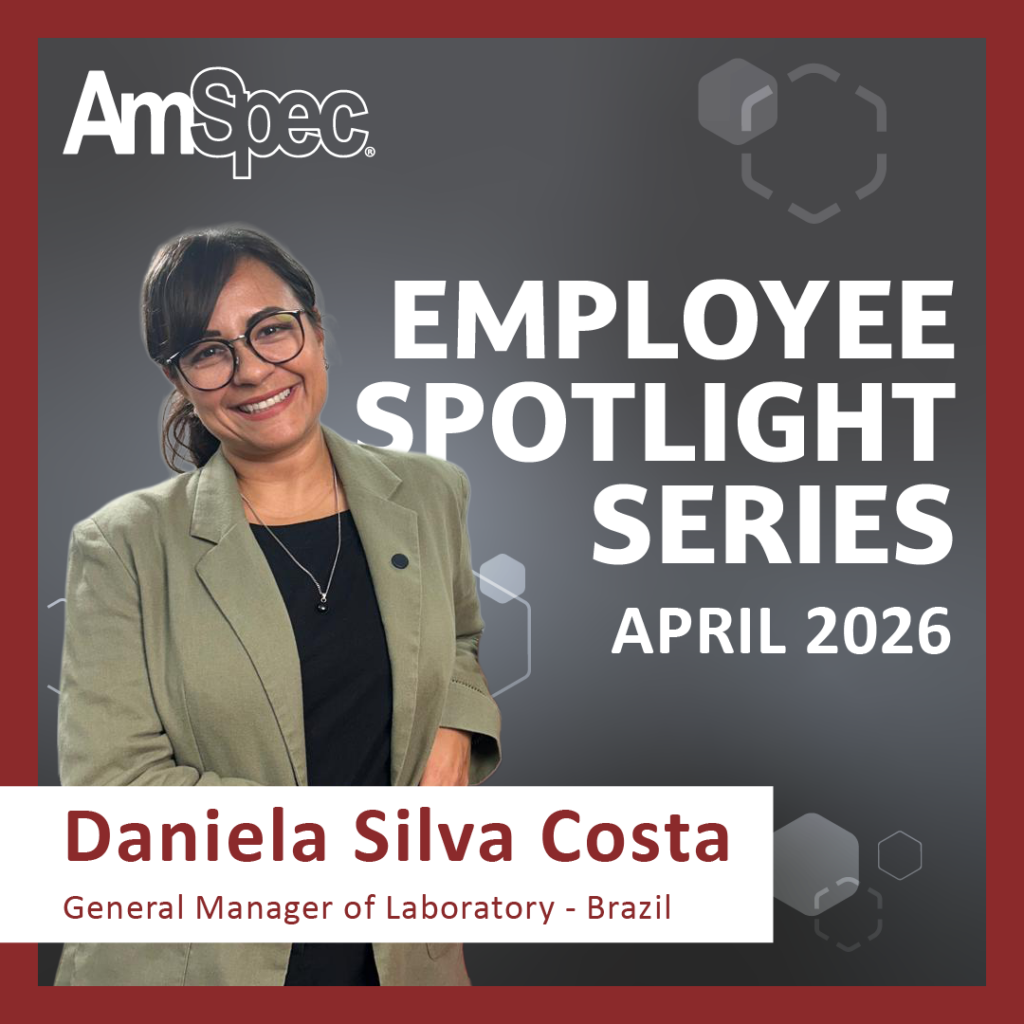
Tell us a bit about yourself and how long you have been with AmSpec.
My story began in a small town in the middle of Brazil (Itajubá/MG), a story of a little girl who dreamed of exploring the world, even though it seemed impossible. But with the support of family and friends, hard work, and a passion for science and technology, the little girl was able to start exploring the world, working in service companies and research centers focused on the Oil & Gas, Fuels, and Biofuels industries. I joined Amspec in June 2023, after 16 years working in laboratories, and my journey within the company is helping me to keep the little girl’s dreams alive.
Can you briefly describe your role as General Laboratory Manager and what it entails on a daily basis?
I am responsible for ensuring that all laboratories in Brazil operate to the highest quality and performance standards. In practical terms, that means I need to manage equipment, procedures, and people to ensure all resources are aligned, maintained, and standardized. The role also includes developing new analytical capacities, implementing new technologies, expanding the laboratories, and providing client support to address their concerns and data analysis needs.
No two days are the same in a lab. What has been the most interesting or unusual project your team has worked on recently?
We have done so many very interesting projects that it is difficult to mention just one. To me, three projects were the most interesting. Number one: implementation of the renewable feedstocks laboratory in Santos; number two: implementation of the first commercial laboratory in Brazil to perform Crude Assay testing, and number three: development of our own equipment to do Solubility Ratio and Shrinkage Factor in oil samples. These projects brought a lot of knowledge and technology to my country, my team, and me. I feel honored to be part of it.
How have testing standards or methodologies evolved since you started your career, and how does the lab stay ahead of these changes?
In my opinion, the biggest change is the automation of the equipment and data analysis. When I started working in laboratories, we had to collect raw data using manual equipment, calculate everything by hand, and analyze the results with little help. Now, most equipment can collect and process raw data on its own, and we can develop software to help interpret the data. The way to keep the lab ahead of these changes is to be open to learning new solutions and adapting to them, without losing the concepts behind the equipment we handle. Probably the biggest challenge of evolution is keeping the team’s basic knowledge, because even though equipment and software make everything automatic and easier, it is the basic chemistry knowledge and understanding that solve real problems.
Quality and accuracy are the cornerstones of the TIC industry. What steps do you and your team take to ensure absolute precision in your results?
We have a strong quality system in place to standardize procedures and practices across all the laboratories in Brazil. It includes the constant verification and maintenance of the equipment, standardized test methods and procedures, team training, data tracking, usage of certified standard materials, frequent audits, treatment of any situation that demands attention as a priority, and, mainly, the mentality of a continuous improvement process, as the way to keep always moving towards enhancing our capabilities and reliability.
How would you describe your leadership style when managing a team of highly specialized chemists and technicians?
I care a lot about people. Managing people is always challenging because each person is unique, with their own talents, emotions, and ways of handling pressure. Then, my leadership style is to be close to my team and learn about each individual to identify their biggest talents. I strive to explore the best in each person and develop those who are open to growth. I also care about providing sufficient resources and a positive work environment for my team, especially because complex work requires concentration and time to be performed to a high standard.
Our customers often don’t see the inside of the lab. How does the work done in your department directly impact their safety, compliance, or business success?
Our work has a huge impact because our results are not just numbers but the identity of each product we analyze. As the complexity of processes and operations increases, product quality becomes more at risk and must be closely monitored to ensure it is on spec. Also, through laboratory testing, it is possible to investigate uncommon situations, study process improvements, and address questions and concerns about the various possibilities in the fuels and biofuels industry.
What initially attracted you to the field of science and testing? Was there a specific moment you knew this was the career for you?
I guess I was meant to be a “scientist”. While I was still a child, my favorite books were those of Jules Verne. Reading science fiction at a young age drove me to chemistry, mathematics, engineering, and a lot of additional reading. I never thought much about the reasons for choosing this career; it just happened naturally.
How do you see the current regulatory landscape (locally or globally) affecting the way we operate and support our clients?
My perception is that the current scenario is becoming more demanding, requiring deeper technical solutions and explanations as energy sources become more diverse and complex. In the past, everyone would be satisfied just with numbers on their certificate of analysis. Now, a number is not enough; it needs to come with a meaning, which makes our work even more important. While all parties involved understand the meaning of the numbers reported in the certificate, a better interpretation of the data will lead to smarter decisions. That said, the way we operate and support clients plays an important role in the current landscape, as we are the ones who can give meaning to the numbers reported by the laboratories.
When you’re not in the lab ensuring the world’s products are safe, what can we find you doing?
I love traveling and learning about different places, cultures, and languages. And during my trips, one can also find me reading, running, and admiring beautiful landscapes.
Last but not least: Coffee or tea, and what’s your order?
Definitely tea, even though this is an unusual choice for a Brazilian.