
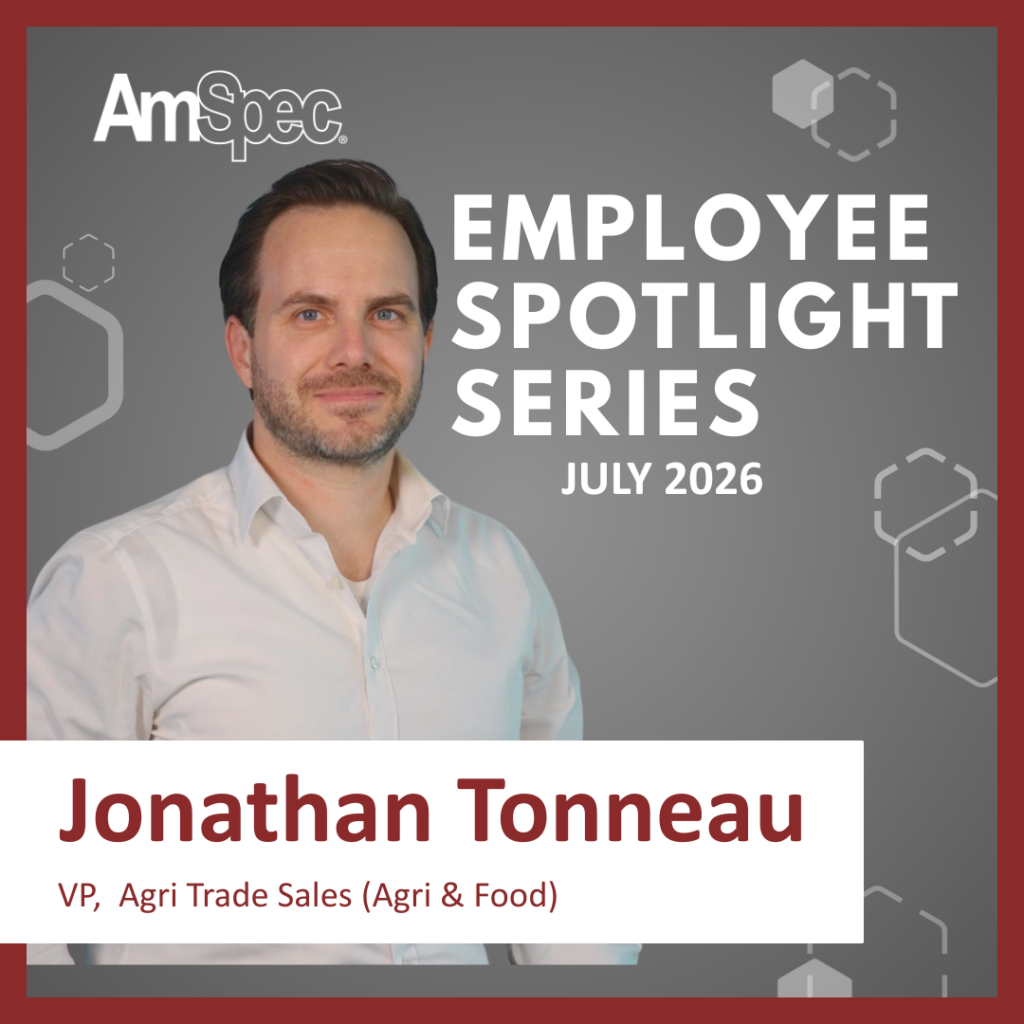
Tell us a bit about yourself, your career journey, and how long you have been with AmSpec.
My journey into commodities started while completing my Bachelor’s degree at Geneva School of Business Administration (HEG Geneva), when I joined a TIC company in 2009 and quickly became fascinated by commodity trading.
I later completed a Master’s degree in Commodity Trading, Finance and Shipping at Geneva University before moving into market analysis at Kingsman, then joining another TIC company, where I held several roles from operations to Product Manager for Feedstuffs.
I joined AmSpec in August 2017, and what I’m most proud of is what we have collectively built since then. We started with a relatively small platform in Agri and today have developed a truly global network with growing technical capabilities and laboratories supporting our expansion.
How would you describe your role to someone outside the agricultural commodities industry?
My role combines commercial leadership, customer management, strategy, and problem-solving. I work closely with global customers, support teams across regions, develop new opportunities, and remain closely involved operationally to ensure customers receive the level of service and expertise they expect.
Ultimately, my role is about helping customers move agricultural commodities around the world safely, efficiently, and with confidence.
The Agri trade sector is constantly evolving. What are the biggest opportunities and challenges you see in today’s global market?
Agricultural trade has become increasingly complex due to regulations, geopolitics, supply chain disruptions, and changing customer expectations. At the same time, increasing focus on food safety, sustainability, traceability, and compliance creates enormous opportunities for companies capable of providing certainty and support throughout supply chains.
What does a typical day look like for you, and how do you balance strategic leadership with supporting clients and teams around the world?
There is probably no such thing as a typical day. Most days start early with Asia and finish late with Europe, North America, or Latin America.
My day is usually divided between customer discussions, supporting teams, solving operational challenges, developing new opportunities, and helping customers navigate increasingly complex logistics.
Leadership in our industry also means remaining available when customers and colleagues need support.
How do testing, inspection, and certification services contribute to building trust and transparency across agricultural supply chains?
Agricultural supply chains involve multiple countries, stakeholders, and significant financial exposure.
Independent testing, inspection, and certification provide transparency and create confidence between parties that may never physically meet. Our role is ultimately to reduce uncertainty and help customers make decisions with confidence.
6. What industry trends do you believe will have the greatest impact on Agri trade over the next five years?
Increasing regulation, food safety requirements, and traceability demands will continue transforming the industry.
Technology will also significantly reshape Agri trade. Blockchain, artificial intelligence, drone technologies, digitalization, automated stock measurements, and faster access to data are already changing how commodities are traded, inspected, and monitored.
Despite this evolution, expertise, relationships, and service quality will remain essential.
Looking back on your career, what achievement or project are you most proud of?
Without hesitation, helping build AmSpec’s Agri division is what I am most proud of.
This achievement is entirely collective. Building teams, expanding globally, developing capabilities, and seeing how far we have come together has been extremely rewarding. At the same time, I believe there is still enormous potential ahead.
What qualities do you believe are essential for success in international agricultural trade?
Technical knowledge is important because customers expect expertise and solutions. Beyond that, responsiveness, adaptability, curiosity, leadership, and problem-solving abilities are essential because no two situations are ever exactly the same. Most importantly, this industry remains fundamentally built around trust.
How would you describe AmSpec’s culture, and what makes it a place where people can grow and succeed?
AmSpec has a strong entrepreneurial culture where people are encouraged to take ownership, create solutions, and contribute beyond their immediate responsibilities. The company has grown significantly while maintaining agility, which creates opportunities for people willing to challenge themselves and grow.
What stands out most for me is the people and the willingness across teams and regions to support each other.
What advice would you give to someone starting a career in the agricultural commodities or TIC industry today?
Stay curious. Learn products, understand logistics, visit ports and laboratories, ask questions, and spend time understanding customers. The agricultural commodities sector may appear simple from the outside, but it is an incredibly complex and fascinating industry.
When you’re not working, what hobbies, interests, or activities help you recharge?
Outside work, I enjoy spending time with my family, traveling, football, running, cooking, and wine tasting.
Coffee or tea and what’s your order?
Coffee. Considering most days start with Asia and finish with the Americas, this is probably less of a preference and more of a survival strategy.