
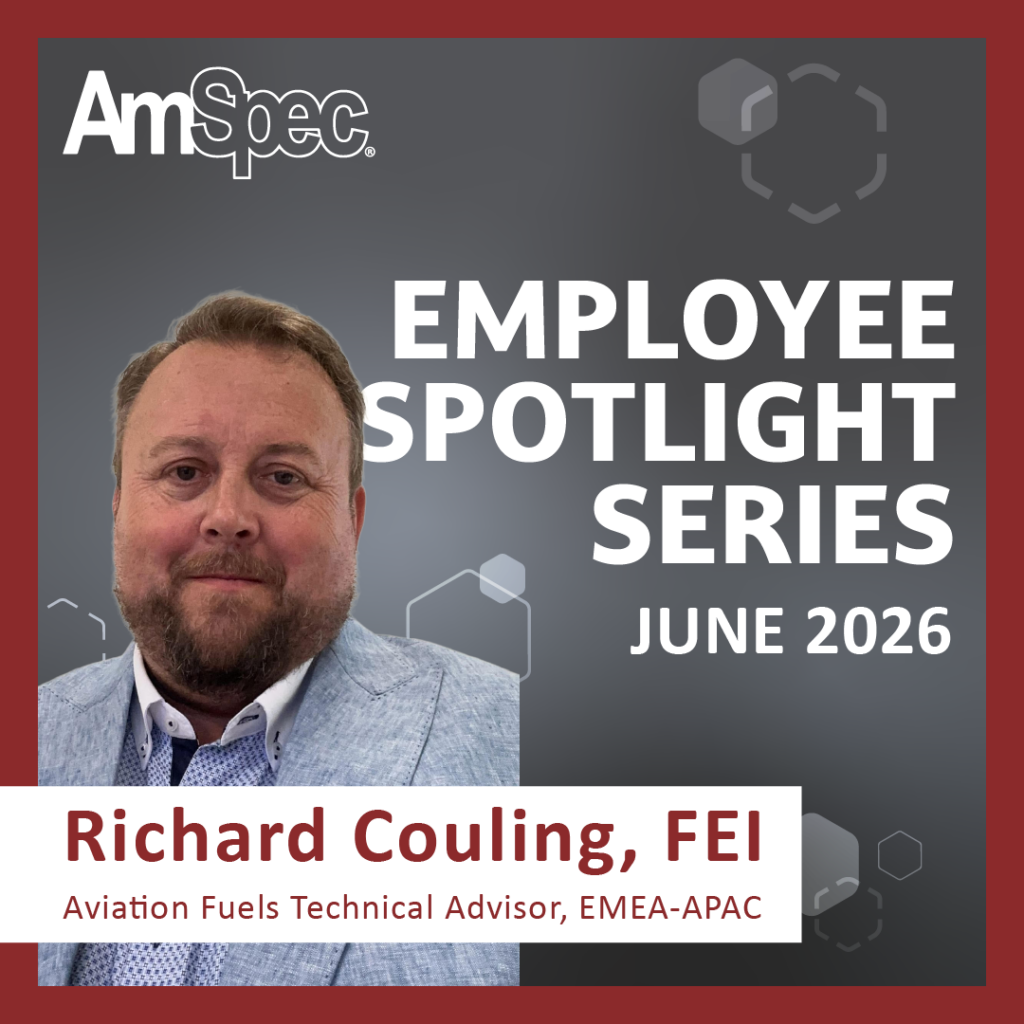
Tell us a bit about yourself and how long you have been with AmSpec.
I am based in Pembrokeshire, UK. My career began in 1989, 37 years ago, in Milford Haven, UK—a very busy oil port with three active refineries back then. I have worked as a surveyor and a lab chemist, and held loss control specialist roles, in addition to country manager and director roles. I have mainly worked in the EMEA-APAC region, including the UK, the EU, and the Middle East (Kuwait, Qatar, Oman, and Saudi Arabia). I joined AmSpec back in June 2018 as Country Manager. I’ve been a full-time Aviation Fuels Technical Advisor since 1st March 2026. This June, I’ve been with AmSpec for eight years.
How would you describe the role of an Aviation Fuel Technician Advisor to someone outside the industry?
SME (subject matter expert) on a very wide range of aviation fuel-related topics, including operational and quality problem solving, providing technical advice and support for preparation and compliance for JIG audits, and providing guidance and training to EI/JIG 1530, EI 1533, and DEFSTAN 91-091 requirements, amongst others. I’m a member of HMC 3 at Energy Institute, helping review industry standards and guidance documents.
What does a typical day look like for you, and how does it balance field support with strategic advisory work?
Every day is different, but this makes the role very interesting. It ranges from providing technical support and guidance to solve active, time-pressured operational and product-quality problems to regular, more structured work, such as reviewing new client projects to ensure they are fit for purpose from design through to final execution. I also travel a lot to provide customers and partners with face-to-face training on relevant standards and procedures, in the comfort and convenience of their own offices and locations.
EMEA-APAC is incredibly diverse in infrastructure, regulation, and business culture. What unique challenges does that pose for fuel advisory work, and how do you adapt?
One of the biggest challenges is managing time zones, from Australia, Singapore, Asia, the EU, and the UK, plus some additional assistance to colleagues in North and South America later in the day. Rarely a dull moment! But there is also an appreciation of different cultures and local requirements across the region, which demands an open-minded approach and an understanding of how things need to work to remain effective in different regions.
With the rise of Sustainable Aviation Fuel (SAF), what new testing and advisory demands are emerging, and how is your role evolving to meet them?
SAF mandates are pushing the industry to provide SAF/SSJF to airports, and with many new pathways for ASTM D7566 Annexes (A1-A8), helping customers plan, adapt, and understand new requirements and even build new production plants and blending facilities is increasingly complex. Supporting everyday blending operations and helping train new industry professionals to guide the industry for years to come is also very important. With all the changes, the industry needs more experts than ever before, at a time when many industry experts have retired or are due to retire. Safety is always the biggest focus in Aviation, so the fuel quality, supply chain security, and product certification are a critically important part of this process, a responsibility that we at AmSpec take very seriously.
How does your work contribute directly to the company’s mission of safety, integrity, and trust in the aviation supply chain?
I truly believe that helping our partners and customers keep their operations compliant with requirements ensures that products are stored, certified, and transported to the highest possible standards, and that Jet Fuel and SAF are supplied fit for purpose, which directly contributes to aircraft safety. Jet Fuel does much more on an aircraft than just being the fuel. It is also used as the coolant for the Turbine gearbox heat exchangers, and more besides, so water separation, cold flow properties, and thermal stability are key factors to maintain fuel safety onboard the aircraft, which keeps everybody safe.
How would you describe the company culture, and what makes it a place where one can truly thrive?
Personally, I love working at AmSpec, having worked at other TIC companies before. Training, knowledge, and experience are key, but people can also thrive when given responsibility and are not micromanaged. I do believe if you really love your job, it doesn’t feel like work anymore. We do this to make a difference and are regularly told by our customers that we do, which is great, but we still keep a focus on continual improvement, too.
How do you measure success in your day-to-day work – what does “a job well done” look like?
Client feedback and appreciation are always rewarding, but the greatest satisfaction comes from helping a client solve a real problem—even when it falls outside our direct scope. Success means identifying the issue, understanding its root cause, and providing an effective solution. In many cases, the simplest solution is the best one, but reaching it requires a clear understanding of the problem. Years of hands-on field experience have been invaluable with this.
For someone aspiring to enter the world of testing and inspection, what’s your best career advice?
Be driven, determined, and focused; don’t wait to be spoon-fed information from others. I learned from reading test methods, specs, and procedures. If you believe in your own abilities and are prepared to put in the effort, you can be very successful.
What industry trend or challenge – beyond SAF – do you think will redefine fuel advisory roles over the next five years?
The Jet Fuel supply landscape is changing. Airports can currently operate only one grade of fuel: jet fuel. So, compared to 100% fossil jet fuel, blended SAF is a “drop-in” replacement for traditional fossil fuel, offering environmental benefits over fossil jet fuel itself. In the future, FSK (fully synthesized kerosene, “non drop-in”) is also expected, which not all “legacy aircraft” (those aircraft in use today) will be able to fly on. This will require additional investment in terminal and airport infrastructure, tanks and pipelines to maintain fuel quality and security. This is a challenge that the industry, regulators, and policymakers are working collaboratively to solve.
What can we find you doing outside work?
I love most things motorsports-related, especially Formula 1 and motor boating. Getting out on the water in my own boat is my happy place, whenever I have time. I do love to travel and spend time with family, too.
Tea or coffee, and what’s your order?
I like English Breakfast tea with milk, without sugar, but I also appreciate a nice double espresso, too.