
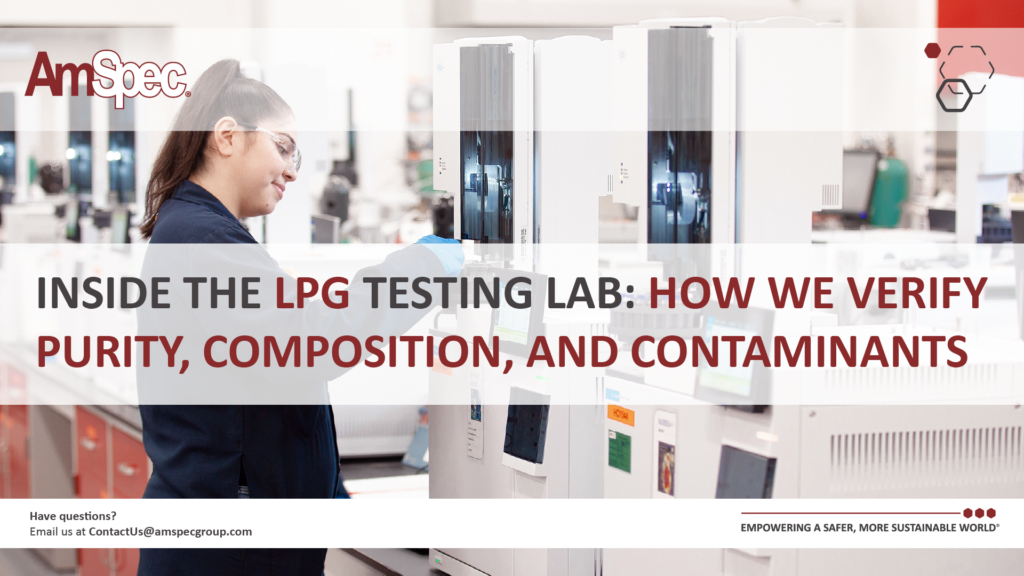
Liquefied petroleum gas is a uniquely valuable product in global energy markets. Whether used for petrochemical feedstocks, domestic fuel, or blending, LPG’s performance and commercial value depend on its purity, composition, and the absence of harmful contaminants. Laboratories play a central role in verifying these qualities, ensuring that each batch meets contractual specifications, regulatory requirements, and safety standards. Inside an LPG testing lab, every step is guided by precision.
Compositional Analysis: The Foundation of Quality
Accurate compositional testing is the cornerstone of LPG verification. LPG typically contains propane, butane, isobutane, and trace hydrocarbons, and its composition governs vapor pressure, energy content, and application suitability. Gas chromatography (GC) is the principal technique for determining composition, with ASTM D2163 serving as the industry standard for detailed hydrocarbon analysis.
Modern GC systems equipped with flame ionization detectors and high-resolution capillary columns enable rapid, repeatable quantification of both major and minor components, including olefins and C5+ species. Temperature-programmed operation improves separation across the carbon range, while automated sampling systems—such as heated valves and pressure-controlled loops—ensure representative introduction of LPG, which is crucial given its volatility. Robust compositional data support accurate calculations of vapor pressure, Wobbe index, and blending characteristics, forming the basis for all downstream quality assessments.
Vapor Pressure and Sulfur Measurement
Because composition directly influences vapor pressure, ASTM D6897 provides a widely used method for quantifying LPG vapor pressure with automated analyzers. Vapor pressure limits are critical for consumer cylinders, aerosol propellants, and petrochemical feedstocks, where improper pressure can create handling hazards.
Sulfur testing is another essential component of LPG quality control. Sulfur affects odorization, combustion, emissions, and catalyst performance. ASTM D6667 and D7551 provide methods for detecting sulfur in the low-ppm range using ultraviolet fluorescence and other advanced detection technologies. Many petrochemical applications require extremely low sulfur thresholds to protect sensitive catalytic processes.
Contaminants: Moisture, Corrosivity, and Residue
Contaminant control extends beyond sulfur. Water contamination poses significant operational risks, as it can freeze in regulators and pipelines or contribute to hydrate formation. ASTM D5454, widely used for water determination in gaseous fuels, measures water vapor content using electronic moisture analyzers based on P₂O₅, Al₂O₃, silicon, piezoelectric, or laser technologies. Vapor-phase monitoring helps operators confirm that dehydration systems are functioning properly and that moisture levels remain below pipeline or distribution limits.
Corrosivity is assessed using ASTM D1838, the copper strip corrosion test. Although simple in concept, the method requires careful temperature control and oxygen-free sample handling to avoid false results. Laboratories also check for heavy ends and residues using ASTM D2158, which identifies non-volatile materials that can foul burners, reduce volatility, or interfere with high-purity petrochemical applications.
Safety in the LPG Laboratory
Safety considerations influence every action inside an LPG laboratory. Because LPG is stored and analyzed under pressure, strict protocols govern sample handling, cylinder preparation, and instrument connection. Certified sampling cylinders with appropriate valves, purge systems, and pressure-relief mechanisms are standard. Samples must be temperature-stabilized to prevent phase separation and ensure accurate measurements.
Technicians perform leak-testing, grounding, and bonding before connecting equipment, while venting systems safely capture and treat released vapors. Laboratory environments incorporate intrinsically safe electrical components, explosion-proof ventilation, continuous gas monitoring, and routinely inspected emergency equipment. These safeguards allow analyses to be performed without compromising personnel safety or data integrity.
Quality Assurance and Accreditation
Beyond technical procedures, laboratory quality systems ensure reliability. ISO 17025 accreditation requires validated methods, documented training programs, and strict calibration practices. Proficiency testing, certified reference materials, and internal QC checks maintain consistency and reinforce confidence in results.
Ensuring Quality Across the Supply Chain
LPG testing is a sophisticated process requiring specialized equipment, rigorous standards, and experienced personnel. The laboratory is not merely a place where numbers are generated—it is the final line of defense ensuring that LPG is safe, compliant, and commercially sound. Accurate testing supports every segment of the supply chain, from production and storage to transport and end-use.
AmSpec provides comprehensive LPG inspection and testing services supported by ISO 17025-accredited laboratories, advanced analytical technologies, and experienced inspectors. From hydrocarbon analysis and vapor pressure determination to contaminant detection and corrosion testing, AmSpec ensures that every LPG shipment meets industry-leading standards for quality, safety, and regulatory compliance.