
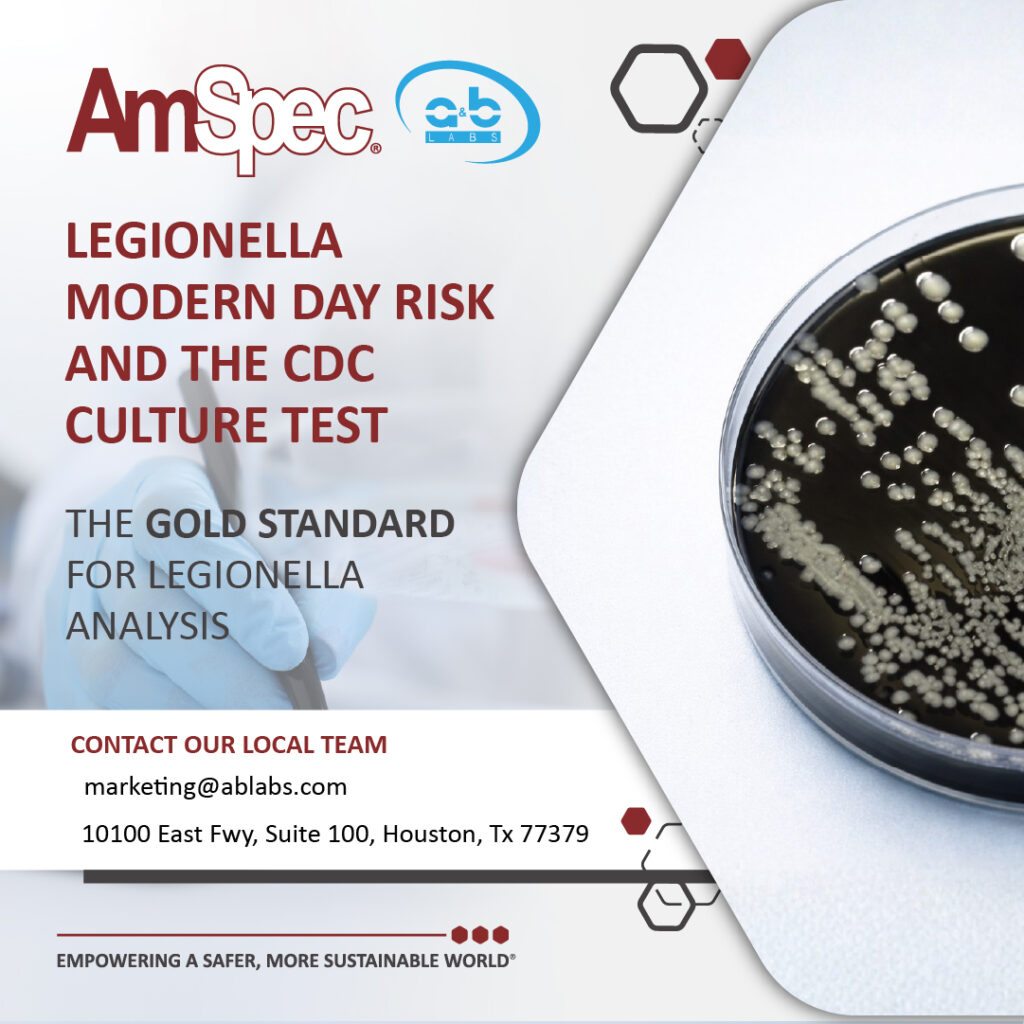
Why CDC Culture Testing Remains Central to Legionella Environmental Testing
Nearly 50 years after Legionella pneumophila was first identified, Legionella continues to pose a significant public health risk across the United States. The risk is not confined to any single region or building type. Any facility with a complex water system can support bacterial growth if conditions allow.
Recent Legionnaires’ disease cases reported in multiple U.S. locations serve as reminders that exposure can occur in everyday environments when water systems are not effectively managed. For facility and building water system operators, Legionella prevention remains an ongoing responsibility tied closely to system design, maintenance, and monitoring.
How Legionella Grows in Building Water Systems
Legionella bacteria occur naturally in freshwater but can multiply in man-made water systems when water becomes warm, stagnant, or poorly controlled. Common environments that can support growth include:
- Building plumbing systems
- Cooling towers
- Water heaters and storage tanks
- Decorative fountains, spas, and other aerosol-generating devices
Transmission occurs through inhalation of contaminated water droplets, not through person-to-person contact. As a result, prevention strategies focus on maintaining water systems that limit conditions favorable to bacterial amplification.
The Role of Testing in Legionella Risk Management
Environmental testing plays a critical role in understanding whether a water system presents a potential health risk. While several analytical methods are available, not all methods provide the same level of insight into actual exposure risk.
Why CDC Culture Testing Is Considered the Gold Standard
CDC-recognized culture testing remains central to Legionella environmental testing because it confirms the presence of viable bacteria capable of causing disease. This distinction is critical for meaningful risk assessment.
Culture testing supports Legionella management by:
- Confirming viable organisms: Culture methods identify living Legionella bacteria, rather than detecting genetic material that may no longer pose a risk.
- Supporting outbreak investigations: Environmental isolates can be compared to clinical samples, helping public health authorities identify potential sources.
- Providing serogroup identification: Understanding which Legionella serogroups are present offers an important epidemiological context.
- Meeting public health expectations: In regulated and high-risk environments, culture-based data provide defensible results suitable for compliance, mitigation decisions, and documentation.
Rapid methods such as PCR can be useful screening tools, particularly for routine monitoring. However, they cannot distinguish between live and non-viable organisms with standard DNA-based PCR and qPCR methods; specialized approaches, such as the Viability PCR Method, are required. During outbreak investigations or elevated risk scenarios, culture testing remains essential.
Laboratory Proficiency and CDC Expectations
The Centers for Disease Control and Prevention emphasizes laboratory proficiency in Legionella isolation, particularly during outbreak response and public health investigations. Programs such as the CDC’s ELITE (Environmental Legionella Isolation Techniques Evaluation) Program are designed to ensure laboratories demonstrate consistent capability in culturing Legionella from environmental samples.
For facility operators, working with laboratories that meet CDC proficiency expectations helps ensure that results are reliable, defensible, and appropriate for decision-making.
AmSpec Group’s Approach to Legionella Environmental Testing
AmSpec Group supports Legionella environmental testing as part of its broader environmental testing capabilities.
Within this framework, A&B Labs, now operating as part of AmSpec Group’s Environmental Testing division, provides CDC-recognized Legionella culture testing to support building water management programs and risk mitigation efforts. With decades of environmental testing experience, A&B Labs delivers analytical results aligned with CDC methodologies and public health expectations.
What This Means for Facility and Building Water System Operators
Legionella prevention is not a one-time activity. It is an ongoing process that requires:
- Awareness of system-specific risk factors
- Regular monitoring and testing aligned with guidance
- Reliable laboratory data to support corrective actions
CDC culture testing remains a foundational tool for understanding whether a water system presents a viable Legionella risk. For operators responsible for protecting occupants, defensible testing data supports informed decisions, effective remediation, and long-term risk management.
Frequently Asked Questions: Legionella Environmental Testing
What is Legionella environmental testing?
Legionella environmental testing involves analyzing water samples from building systems to determine whether Legionella bacteria are present and whether conditions may support growth that poses a health risk.
Why is culture testing important for Legionella?
Culture testing confirms the presence of viable Legionella bacteria capable of causing disease. This makes it especially important for risk assessment, outbreak investigations, and situations where public health decisions depend on defensible data.
Are rapid methods like PCR useful for Legionella testing?
Rapid methods such as PCR can be useful screening tools and may support routine monitoring. However, they cannot distinguish between live and non-viable bacteria without additional context, which is why culture testing remains critical in higher-risk scenarios.
When should facilities consider Legionella testing?
Facilities with complex water systems, aerosol-generating devices, or vulnerable populations should consider routine monitoring as part of a broader water management program, particularly following system changes, maintenance disruptions, or reported illness.
Learn More About Legionella Testing Services
To learn more about Legionella environmental testing and how AmSpec Group supports facility water system management, visit our Environmental Testing page or contact our team to discuss your testing needs.
Sources
Legionella risk & occurrence
- EPA: Legionella and human health risks (water systems & exposure) US EPA
- CDC routine testing guidance (objectives & methods) CDC
Testing methods & standards
- CDC control toolkit and guidance (culture vs other methods) CDC
- ELITE program proficiency & outbreak support CDC
Routine testing interpretation
- CDC on Legionella results and building management context CDC
Recent outbreak example
- Florida Legionnaires’ cases reported (nationwide risk reminder) Good Morning America