
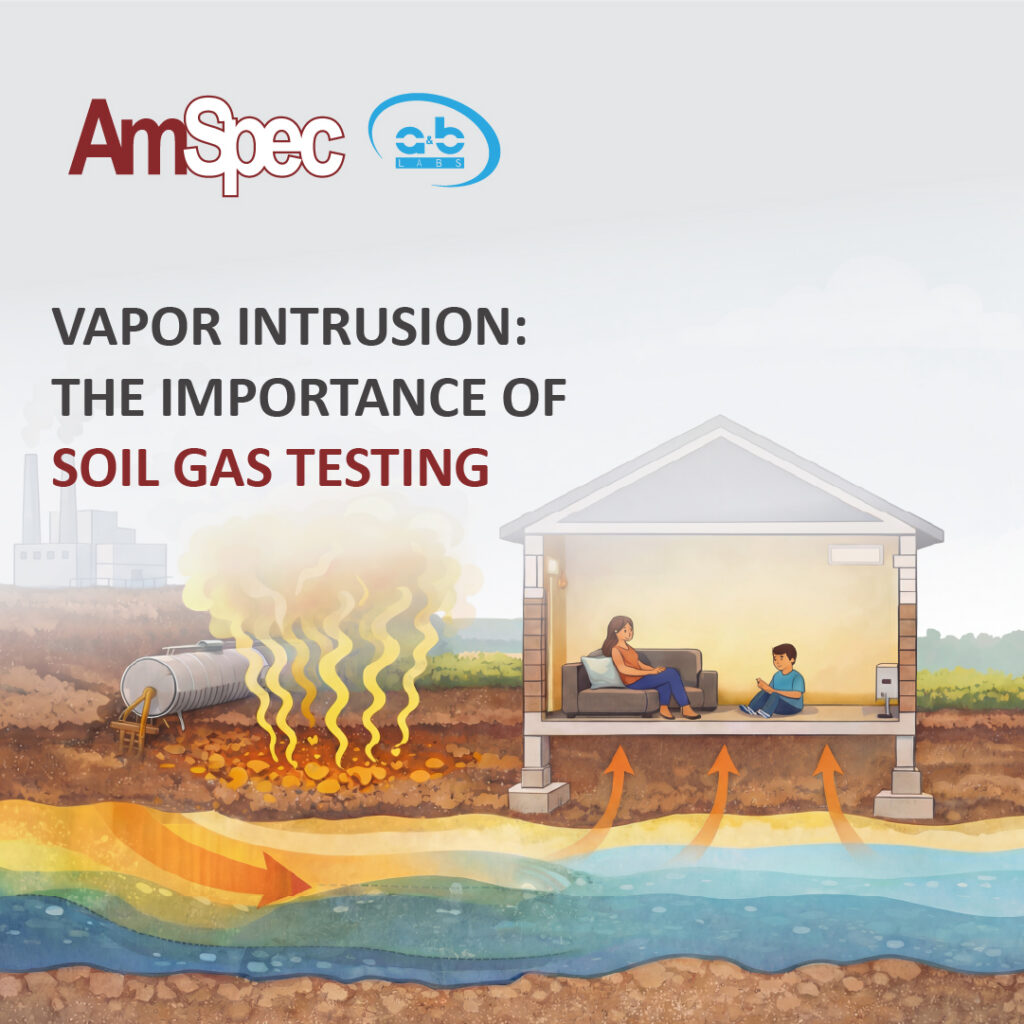
Executive Summary: Why This Matters
The movement of volatile chemicals from contaminated soil or groundwater into buildings can directly affect real estate transactions, government facilities, schools, and redevelopment projects. Decisions tied to these investigations frequently are sought to answer the question…is the data collected defensible, interpretable, and fit for purpose.
Vapor intrusion occurs when VOCs present in contaminated soil or groundwater volatilize into soil gas and migrate upward into buildings through structural pathways such as cracks in foundations, utility penetrations, expansion joints, or slab imperfections. Once inside, these vapors can accumulate and contribute to indoor air concentrations that may pose health or regulatory concerns.
The compounds most commonly associated with vapor intrusion include chlorinated solvents such as trichloroethylene (TCE) and tetrachloroethylene (PCE), as well as petroleum related compounds like benzenes. Often you may find conditions are frequently encountered at former dry cleaners, fueling stations, industrial or manufacturing properties, urban redevelopment sites, and buildings with long or complex land-use histories, including government and public-use facilities.
Soil gas sampling plays a central role in vapor intrusion investigations because it measures vapors before they enter a structure. Unlike indoor air sampling, which can be influenced by variables such as, consumer products, ventilation patterns, occupant behavior, and outdoor conditions, soil gas analysis provides a clearer window into subsurface vapor sources and migration potential by characterizing vapor concentrations beneath or adjacent to a building. Effectively, soil gas analysis functions both as a predictive and diagnostic tool allowing us to take preventive measures or appropriate restitution to protect our health by identifying the strength of the subsurface source, potential migration pathways, and the likelihood that vapors could impact indoor air rather than simply a confirmation step after indoor air impacts are observed.
TO-15 vs. TO-17: How Method Selection Actually Works
For vapor intrusion investigations, EPA Method TO-15 using summa canisters is the most widely used analytical approach, but it is not universally sufficient on its own. Because although canisters can work well for sub-slab soil sampling, certain site conditions such as shallow groundwater, fine-grained soils, or wet sub-slab may present condensation risk which can introduce uncertainty. For these reasons the use of sorbent tubes, or EPA Method TO-17 may be more appropriate to complete your project goals. In these cases the use of sorbent tubes to capture VOCs from a controlled volume of air, offers ideal advantages when moisture, concentration levels, or compound behavior complicate canister based sampling. Furthermore sorbent based sampling selectively retains target compounds while allowing moisture to pass through, reducing the potential for sampling artifacts. Sorbent based sampling with TO-17 specifically also allows tighter control over sampled air volume, making it better suited for higher-load scenarios as well.
In addition, some investigations focus on specific compounds or heavier VOCs where improved retention is beneficial. Petroleum sites or mixed-use properties may require targeted performance rather than broad screening. In high-stakes or litigation-sensitive investigations, pairing TO-17 with TO-15 can strengthen the overall line of evidence, particularly when results fall near screening thresholds or are subject to dispute.
Ultimately vapor intrusion is not defined by a single analytical method. Defensible investigations align sampling strategy with site conditions, chemical behavior, and decision risk. In many cases, conclusions are reached by using TO-15 as a foundational screening method, supported by TO-17 as a targeted or confirmatory tool where uncertainties exist. It’s important to remember for commercial properties, schools, and government buildings, vapor intrusion data can directly influence property value, transaction timelines, occupant safety decisions, regulatory closure, and development planning.