
The energy and petroleum supply chain has become increasingly complex, with new fuel types, evolving regulations, and tighter quality expectations shaping every transaction. In this environment, many challenges faced by refiners, traders, and terminal operators stem not from the testing itself, but from misunderstandings about how inspection, sampling, and laboratory analysis actually work. As fuel specifications grow more technical and supply chains become more global, education has become one of the most powerful tools for reducing disputes, improving decision-making, and building trust between inspectors and clients. This is why AmSpec continues to expand its Inspection 101 programs and hands-on laboratory tours, giving clients a clear window into the processes that protect product value every day.
Many clients arrive at an inspection site familiar with contract terms and ASTM specifications, but less familiar with the real-world challenges inspectors face in the field. Tank accessibility, safety constraints, weather, storage history, equipment limitations, and operational timing all influence how an inspection is carried out. A classroom explanation of ASTM D4057 or API MPMS Chapter 8 can only go so far; seeing how these procedures unfold in an actual terminal environment bridges the gap between theory and practice. AmSpec’s Inspection 101 sessions demonstrate how representative samples are collected, how temperature and water measurements are taken, and how surveyors document abnormalities or limitations. These sessions help clients understand why certain procedures take time and why deviations from proper technique can affect both quality and quantity outcomes.
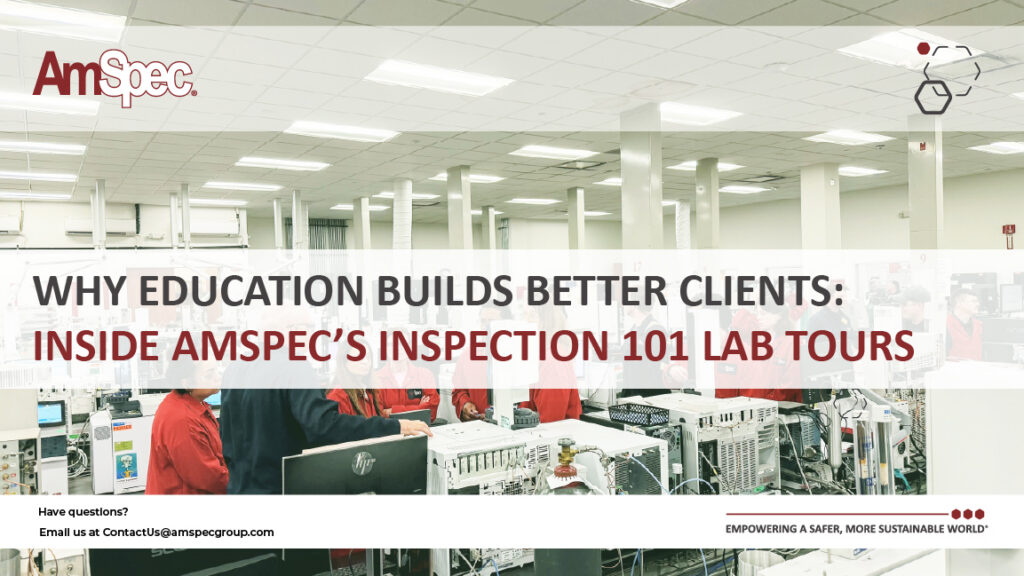
Laboratory tours add another dimension to this educational experience. Many clients rely on lab results during custody transfer, but few have seen how a modern ISO 17025-accredited fuel laboratory operates. Walking through the workflow—from sample login and chain-of-custody procedures to distillation units, sulfur analyzers, flash point instruments, and GC-MS equipment—helps clients understand the discipline required to produce accurate results. They see how calibration standards are maintained, how analysts verify instrument performance, and how repeatability and reproducibility influence the interpretation of data. When clients understand the complexity and rigor behind each result, they become better equipped to evaluate differences between labs, interpret unexpected results, or understand why turnaround times vary depending on the method.
Education also significantly reduces disputes. Many cargo claims, particularly in marine and pipeline operations, arise not from true product off-specification but from misunderstandings of test-method precision or sampling variability. When clients understand how ASTM precision statements work, or why two laboratories may legally differ within method reproducibility, it becomes much easier to assess whether a discrepancy is operationally meaningful. Inspection 101 programs guide participants through real examples—such as density variances, water differences, or octane shifts—to illustrate how method limits shape commercial decisions. This often saves time, reduces frustration, and prevents unnecessary conflict between buyers and sellers.
For clients transitioning into new markets, education is equally important. With the rise of renewable fuels, synthetic components, and emerging compliance frameworks, many companies find themselves navigating unfamiliar territory. Understanding the testing requirements for biodiesel blends, sustainable aviation fuel, pyrolysis oil, or renewable diesel requires a deeper knowledge of laboratory techniques. Clients visiting AmSpec labs see how oxidation stability tests are performed, how metals are detected in waste-derived oils, and how advanced instruments measure carbon intensity indicators. This exposure helps them prepare for compliance with programs such as the EU Renewable Energy Directive, IMO fuel-quality rules, or domestic carbon-intensity reporting.
Perhaps the most important benefit of onsite education is the strengthening of relationships. When clients understand the work that inspectors, coordinators, and lab technicians perform, they engage more collaboratively. They ask better questions, share relevant operational details, and gain confidence in the integrity of the inspection process. The partnership becomes more transparent and more productive. This matters because in the energy industry, trust is built not only through technical accuracy but through shared understanding of how that accuracy is achieved.
AmSpec offers Inspection 101 and customized lab tour programs across multiple global locations, giving clients a practical, immersive view of the inspection and testing processes that safeguard their operations. Through hands-on demonstrations, method explanations, and real-world sampling scenarios, AmSpec equips clients with the knowledge needed to make informed decisions, interpret results correctly, and work more efficiently with inspection teams. By investing in client education, AmSpec helps strengthen the entire supply chain—one informed partner at a time.